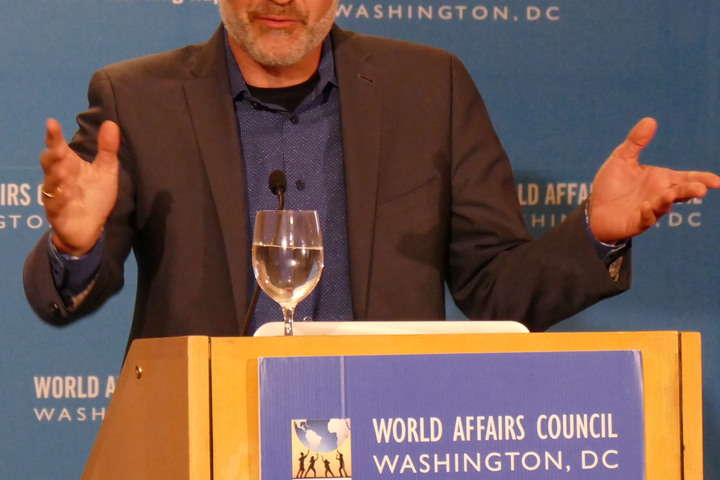
WASHINGTON, DC, USA - On April 18, 2017, the World Affairs Council hosted Dr. Philip Auerswald for an Author Series event to discuss his new book, “The Code Economy: A Forty-Thousand Year History”. Dr. Auerswald is a professor of public policy at George Mason University and a Senior Fellow at the Kauffman Foundation. He also serves as the co-founder and co-editor of Innovations, a journal that focuses on entrepreneurial solutions to global challenges.
Dr. Auerswald led the presentation by explaining that it is important to understand the distinction between headlines and the trendlines associated with them. For example, he cited a headline stating “There will be 9 Billion People in the World by 2050” and discussed the underlying trendline of increased competition for resources that results from increases in population. He utilized this point to introduce four major trendlines, which he called the “four certainties”, which he claims can help us understand our future global economy.
The first certainty Dr. Auerswald presented was that of declining fertility rates. In every region of the world but sub-Saharan Africa, data shows that fertility rates have are steadily declining over time. This, he contended, leads to an influx of foreign workers to fill labor gaps. If these workers are not properly integrated, socio-economic conflict is likely to occur.
The second certainty discussed was the inevitability of the return of populations to density. Population surveys continue to show a trend of urbanization in the United States. However, Dr. Auerswald explained that this trend is not unique to the US, as it also shows in Turkey, the United Kingdom, and France among other countries. He claimed that the economic inequalities created by this trend can help explain the political polarization between rural and urban population centers.
The advance of code, Dr. Auerswald’s third certainty, relates to the increasing pervasiveness of coded technology in modern society. The main point of this section of his presentation was that technology today continues to build upon previous platforms, thus allowing humans to continually innovate.
Finally, the fourth certainty deals with what Dr. Auerswald called “the ratio” of human lifespans to those of institutions. He contended that as human life expectancy has increased, the institutions, or more specifically, the social norms typical of modern society are shorter-lived.
Dr. Auerswald concluded his presentation by expressing his confidence in mankind’s ability to adapt and improve in the code economy.