Something
extraordinary is happening in Leeuwarden. The Friesian capital has quietly
grown into the epicentre of innovative water technology. The Leeuwarden Water
Campus is the breeding ground for numerous technological innovations and
successful water start-ups. The city, province, water technology sector and
educational institutions work together intensively. The Water Alliance helps
companies to bring their innovations to the market faster.
The
Water Alliance
, member of WTC Leeuwarden, was set up more than ten years ago as a
network organisation for the water technology industry. The organisation, which
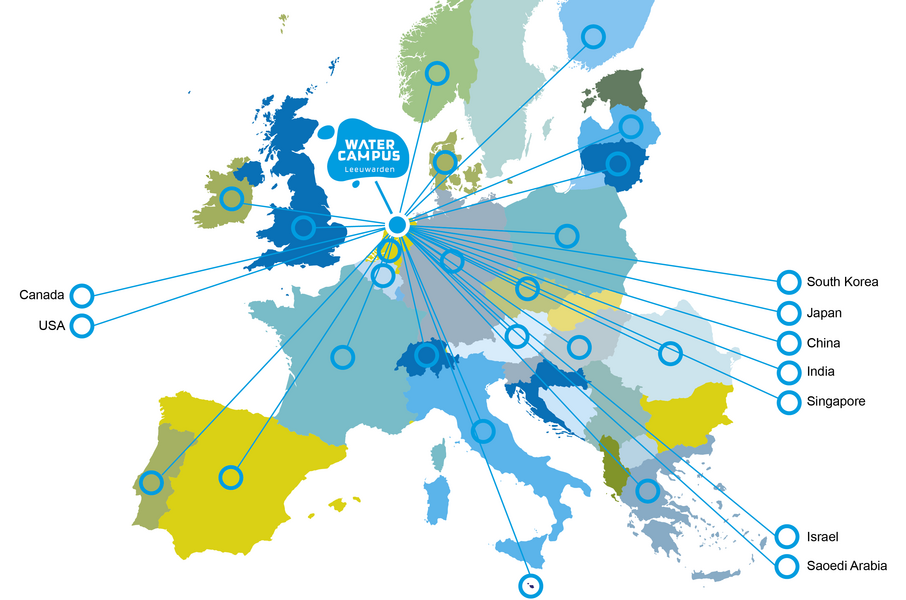
originally started as a northern initiative, now fulfils a nationwide role with
global connections, says managing director Hein Molenkamp. The Water Campus in
Leeuwarden was chosen as the location for the event because of the presence of
Wetsus
, the largest research centre in the field of sustainable water
technology. "Wetsus is a world-renowned research institute. It is the
scientific foundation of the Water Campus. Universities from all over Europe
carry out research in cooperation with the business community in the Wetsus
laboratory.
Niche
character
Asked about
the core of the Water Campus's success, Molenkamp answers: "We are able in
a down-to-earth way to complement complex university research with applied
research, including the CEW
(Centre of Expertise Water Technology). We are also
intensively involving intermediate and higher vocational education, after which
companies will eventually take the technology to the global market. The
philosophy behind the Water Campus is how, through intensive cooperation, we
can play a role in accelerating the development and scaling up of ideas via
research and applied research into marketable technology. Selling and exporting
new technology is very nice, but the road to it is often long. There are many
examples of new water technologies that took at least ten to fifteen years to
develop before they became commercially successful." A characteristic of
Dutch water technology is that it is mainly SMEs, Molenkamp explains.
"Some companies have grown just a bit above SME level, but the majority
are more between 5 and 60 employees. Many of these companies are very
export-oriented. The Dutch market for their specific technology is small, due
to its niche nature, so as an entrepreneur you soon look across the border. The
market for new solutions to the ever-growing global demand for water is
enormous."
Wastewater
On the
Water Campus, science and business work together on numerous challenges, such
as new processes for clean drinking water, the purification of waste water,
recovering useful substances from water to industrial applications and even
sustainable energy production such as Blue Energy on the Afsluitdijk.
There are
several examples of successful innovations and start-ups that illustrate the
Water Campus. One example is the company Hydraloop
, also a member of WTC
Leeuwarden. The idea started with a resident of Muiderberg, who developed a
device in his garage that reuses wastewater in the home, reducing the need to
dispose of wastewater by half. "He came into contact with us a few years
ago. That product was fairly well developed, but many steps are needed before
you can take your technology to the market. They have established themselves at
the Leeuwarden Water Campus and we have taken the company to various major
exhibitions in cities including Amsterdam, Abu Dhabi and Chicago. They also
participated in various innovation competitions. The highlight was the CES
in
Las Vegas in 2020 where they received the highest innovation award. That
generates a lot of attention. We put them in touch with a network organisation
friend of ours in the US, where they eventually opened their first office, to
get a foothold in North America. That's the role of Water Alliance. We connect
parties."
At the same
time, Hydraloop had to start production. "Through our relationship with
the NOM
(Investment and Development Agency for the Northern Netherlands), they were put in touch with Technologies Added
in Emmen, a turnkey
factory where they could set up their own production line. For such a start-up,
that is a welcome addition."
The
government also supports the innovations, Molenkamp says. For example, the
municipality of Leeuwarden is the first in the Netherlands to make a subsidy
available for installing a water-recycling system in houses. In a neighbourhood
in the Frisian capital, such a system has already been installed in dozens of
homes. Molenkamp: "That is very important for a starting entrepreneur,
that you have a platform nearby to launch your product, so that you can prove
that your idea works. The region is very committed to providing such a platform
for new technology. Hydraloop is a great example of that."
Another
company Molenkamp likes to mention is Wafilin Systems
. The company specialises
in purifying water from industries by means of membranes. One of its customers
is Avebe
, which produces potato starch. "That process is becoming
increasingly circular. Together with Wafilin Systems, for example, they have
developed a technology whereby protein is extracted from the process water by
means of a special membrane technology. As a relatively small SME, they are
still able to carry out a project of around 6 million euros through intensive
cooperation with numerous supplying companies. Personally, I find that one of
the fascinating things about my job. You see that companies that develop
high-grade water technology work together with numerous supplying manufacturing
companies to carry out projects. If that succeeds in the Netherlands, the door
to global expansion is open. And that is good for Dutch business."
Hub
Water Campus
Leeuwarden is the hub of the Dutch water technology sector. It has the ambition
to fulfil this role for the whole of Europe, thus strengthening the position of
European water technology.