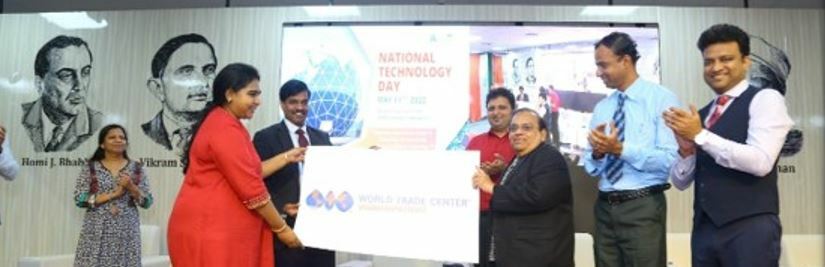
WTC Visakhapatnam opens its Interim Office

May 31, 2022

The World Trade Center Visakhapatnam has opened its interim office at Andhra Pradesh Meditech Zone( AMTZ).  On 11th May 2022, WTC Visakhapatnam inaugurated its interim office on the 4th Floor, Pyramid Towers, AMTZ Campus of AP Medtech Zone. We share the building with the World Health Organization on the 3rd Floor and the BRICs Indian Secretariat on the 5th Floor.

The inauguration of the interim office is grace by Dr. Jitendra Sharma, known as the Meditech man of India and his team. The main objective of setting up the interim office at AMTZ Zone is to promote the export of medical equipment manufactured at AMTZ. AMTZ is India's leading medical technology manufacturing cluster, with specialized laboratories, warehousing, and common manufacturing & testing centers like the Center for Electromagnetic Compatibility and Safety Testing, Center for Biomaterial Testing, Center for 3-D Printing, Centers for Lasers, MRI Super Conducting Magnets, Gamma Irradiation Centre, Mold & Machining Centre, and many other industrial service centers.

Visakhapatnam is also a hub for many MSMEs and is part of the Petroleum Chemical and Petrochemical Investment Region (PCPIR). Visakhapatnam is the port city termed as Gateway of the East due to its widespread coastline. Being a port city, there is a huge impact on the blue economy. We at WTC Visakhapatnam would like to be part of the same by spreading the message on conservation of the oceans and ecological balances apart from using the resources effectively.

More News

PARTNERS WITH TIE HYDERABAD FOR STARTUP SERIES - 6

August 31, 2024 - In May 2024, the World Trade Centers in Shamshabad and Visakhapatnam, in partnership with TiE Hyderabad, launched an exciting new startup series. This edition will feature a Hyderabad-based startup that specializes in transforming traditional Indian grandmother recipes into convenient frozen meal formats. Snackerstreet, a Hyderabad-based startup, is on a mission to revolutionise the frozen food industry. The company is making waves with its innovative approach to preserving the flavors of India. “We aim to deliver any product, traditional or modern, in the conveniently frozen form, without any added preservatives, just like how a chef makes it, but on a much larger scale,” says Co-Founder Divya Medar. With a strong emphasis on quality and customer satisfaction, Snacker Street is rapidly expanding its footprint both domestically and internationally. As Medar puts it, “we are the brand behind brands.” In an exclusive interview with the Hans India, Divya Medar, Co-Founder & Director, Snackerstreet, shares her journey, the company’s vision, and its plans for the future Q. How have your previous experiences shaped your approach to leading Snackerstreet? Ans. I have been fortunate to have mentors and strong family support that has helped me prioritise and develop myself into the person that I am today. They, along with my formal networks have helped me build a strong business model that contributes to the ecosystem in a unique way. Q. What are the key strategic priorities for Snackerstreet in the current market landscape? Ans. To be able to deliver any product - traditional or modern, in the conveniently frozen form, without any added preservatives, just like how a chef makes it, but on a much larger scale. We aim to export to at least two countries this year, to bring a larger, more diverse basket of Indian food to aware consumers across continents. We have set up a new factory that is export oriented and is FSSC 22000 certified to achieve these goals. Q. How does Snackerstreet approach innovation within the food sector, and can you highlight any recent developments or initiatives? Ans. Snackerstreet develops customised recipes for its clients - food businesses like cloud kitchens, fast food brands/QSR Chains, Seafood processors, FMCG Brands and Export Houses. We enable them to offer unique products that help them differentiate themselves from other competitors in the marketplace. We have developed traditional Indian grandmother recipes in the frozen meal format - these ancient recipes can now be conveniently enjoyed by one and all! We are thus, the brand behind brands. Q. What have been some of the biggest challenges you’ve faced while leading Snackerstreet, and how have you navigated them? Ans. As a startup founder when ‘startup’ was not an ‘in’ thing, it was difficult. I was barely 23, would not be acknowledged in bank and client meetings, clients would not say yes, but wouldn’t say no either, there would be awkward moments or price and term negotiations. People who were invested in me were protective in all good faith, but that made me second-guess myself. It took me a long time to trust myself to take bold, calculated, risky decisions. I am proud of who I have become. Q. What impact does Snackerstreet aim to have on the food industry, both locally and globally? Ans. Enabling food businesses to scale and create their individual, unique value proposition, and hence become more successful and profitable. To export more India-made food products that deliver high quality and diverse representation of Indian foods to the global arena. To deliver value added products using fresh farm produce to aptly represent the true value chain of our Indian food processing industry - to ensure that this garners the higher rupee value for our agricultural produce and hence truly does justice to our produce. Q. How does Snackerstreet prioritise customer satisfaction, and what measures do you take to ensure high-quality service and products? Ans. Snackerstreet is only B2B. Our top-selling product today is made on the suggestion of a chef. Any relevant feedback given by our varied stakeholders, are taken and implemented for them, at scale. We make it for them, to ease the burden on them, so that they can deliver their menus exceptionally well, without time and resource pressure. We are FSSC 22000 certified by a certifying body of repute. This means that each of our processes has been monitored over many days to optimize production steps for highest hygiene, safety and consistency of output. We also have a technically qualified and trained team in place with SOPs and GMPs to ensure consistent deliverables. And this being food, our recipes have been standardized and we also personally taste each batch on various sensory parameters to ensure the best deliciousness possible. Q. Can you discuss a successful partnership or collaboration that has contributed to Snackerstreet’s growth? Ans. No one single partnership can be attributed to our growth. Having said that we have had continued relationships with our stakeholders over the years, which have grown since we have delivered on our promises, on time, every time, consistently and have been able to customize offerings basis of their needs. This customer centric approach has what has helped us sustain and define our company over this period of time. Q. What emerging trends in the food industry do you believe will shape Snackerstreet’s future strategies? Ans. As a company, we believe in frozen food being the closest to homemade/handmade/chef-made food. This I believe is going to continue as a trend. Apart from this, food trends come and go. Traditional cuisines will live on, thanks to technology. Convenience and health will become the focal point of food purchase and taste will be paramount- a given. Q. How has the ecosystem and support from other businesses or organisations like TiE Hyderabad helped in Snackerstreet’s journey? Ans. Being in the same boat as other fellow entrepreneurs gives me the strength to learn, contribute and continue to excel at what we do at Snackerstreet. The mentors, sponsors and friends I have made through the TiE network have offered me various safe spaces that one can well use in the otherwise lonely journey of entrepreneurship. The various learning opportunities the platform offers, also enables one to share and learn from one’s own journey, apart from that of others. Read More

PARTNERS WITH TIE HYDERABAD FOR STARTUP SERIES - 5

August 31, 2024 - The World Trade Centers in Shamshabad and Visakhapatnam, in collaboration with TiE Hyderabad, have launched an exciting new startup series in May 2024, IKP supported over 1,500 startups across India in 25 yrs, says CEO Chattopadhyay Established by ICICI Bank in the late 1990s, IKP Knowledge Park was envisioned as a research park to help India transition into a knowledge economy. Located at Genome Valley, Hyderabad, IKP stands out as a unique industry-led science hub, fostering collaboration between academia, industry, and government. “I have always been inspired by science and have been exploring diverse avenues to make a difference on the ground through science & technology-based interventions,” says Deepanwita Chattopadhyay, Chairman & CEO of IKP Knowledge Park, in an exclusive interview with The Hans India. “Leading IKP was a dream come true. Starting from scratch and learning from global benchmarks, it’s been gratifying to see IKP’s growth and its impact on India’s innovation landscape over 25 years,” she adds. Q. What inspired you to venture into the field of science and technology innovation? Ans. I have always been inspired by science and have been exploring diverse avenues to make a difference on the ground through science and technology-based interventions. This included research in electronics, teaching in a top engineering college, working with NGOs on science-based writing to starting a hands-on science museum and working at the telecom advisory division of ICICI. Around 1998-99, ICICI’s the then-Chairman Narayanan Vaghul was contemplating setting up a research park to help India transition into a knowledge economy in the new millennium. This vision culminated in the creation of IKP Knowledge Park, and I was drawn into it, first to coordinate the activities and then to lead the organisation. In a pivotal moment for India’s innovation landscape, ICICI Bank considered three cities for this new venture: Bangalore, Pune, and Hyderabad. Hyderabad, under the then-Chief Minister N Chandrababu Naidu, emerged as the chosen city and the government offered 200 acres of land on the city’s outskirts. This area, which later became known as Genome Valley, was initially a desolate stretch with minimal development. Bharat Biotech was the only significant company present in the area at the time. Leading IKP was a dream come true. ICICI’s choice of a greenfield project, not inside or next to an academic institution or university, allowed us to build a unique, industry led science hub and inspired me to venture into science and technology innovation. Starting from scratch and learning from global benchmarks, it’s been gratifying to see IKP’s growth and its impact on India’s innovation landscape over 25 years. Q. Can you also let us know the challenges you faced, while developing IKP as a leading innovation hub in the life sciences sector? Ans. Designing IKP was like ‘sculpting fog,’ as it was aptly described by one of the co-founders and mentor of IKP, Dr BalaManian. Building a new model in India without any existing benchmarks was challenging. Engaging industry and academia required significant effort despite support from eminent people like Dr. RA Mashelkar, former DG – CSIR and Dr Ashok S Ganguly, then Chairman, Hindustan Unilever, both Directors on the Board of IKP. Convincing the first few customers to come to a remote location with poor basic infrastructure required significant effort. Setting up customizable, shared research facilities for a range of different needs, developing policies around running a science park, and implementing guidelines for example to prevent poaching of employees from within the Park resident companies, thus instilling trust, were challenges we had to overcome. Securing funding from the National Science & Technology Entrepreneurship Board, Department of Science and Technology to set up an incubator was also another challenge, which made us the first private incubator in 2006 to receive government incubation support. Since then IKP has grown into a thriving hub and supported over 1,500 startups and innovators across India, including around 500 from Hyderabad. Q. What does IKP do differently in terms of access to resources, mentorship, or funding to ensure the success of startups? Ans. IKP takes a tailored approach, assessing each startup’s unique ideas and providing customized mentorship and guidance. By connecting startups with specific mentors and guiding them on suitable funding opportunities, this personalized support has enabled us to successfully assist over 1,500 life sciences and high-tech startups, fostering their growth and success. Q. How do you enhance collaboration between academia, industry, and government at IKP? Ans. At IKP, fostering collaboration between academia, industry, and government is central to our mission. Our collaboration began with support from the state government and the Department of Science and Technology (DST) for incubation activities. BIRAC has been a vital partner, running numerous programs with us, through initiatives like BIRAC’s BIG (Biotechnology Ignition Grant) program, which supports early stage innovative ideas to establish their proof of concept. With MoUs with around 60 academic institutions and a dedicated tech transfer office, we help translate academic innovations into market-ready technologies. Our collaboration with the Gates Foundation’s Grand Challenges Exploration program in 2011, for example, played a key role in the innovation ecosystem. By scouting for out-of-the-box ideas in academic institutions and startups to solve global health challenges, we not only strengthened our links and expanded our network, we also paved the way for large scale adoption of Grand Challenges and challenge grants by all institutions in the country. Through our tech transfer office and grant programs, we ensure academic innovations reach their potential, driving success and impact in the field. Q. How do you see IKP impacting the broader economic region and its growth, particularly in terms of job creation, research and development investments, and contributions to technology and healthcare innovation? Ans. IKP is a catalyst for regional economic development and job creation. Major MNCs like DuPont, Daicel, Adama, ITW and US Pharmacopeia, alongside mid-size and emerging companies such as EPR Pharma, Nectar Therapeutics, Advanta, Laurus Labs, Sirona, Escentia, Epsilon among others, have driven cutting-edge innovation and product development here. IKP has also been home to very successful CROs including Matrix Labs, GVK Bio, Sai Life Sciences, Curia, Laxai, Laurus and Mithros Chemicals. Their success fosters a dynamic environment for others to thrive. Our focus on innovation extends beyond research. Companies and their employees have spun off new ventures or infused other businesses with a culture of innovation. IKP has directly created around 15,000 jobs, with an additional 60,000 in indirect employment. Our startups, such as Laurus Labs, which evolved from an API provider into a major pharmaceutical player, expanding into biologics and investing in cell and gene therapy, demonstrate impact. There have been several startups that have demonstarted scale across domains ranging from healthcare. medtech and biopharma to renewable energy, agriculture, mobility and sustainability. Overall, IKP’s contributions to technology, healthcare, and job creation underscore its role as a significant economic driver and innovation hub. Q. What advice would you give to young entrepreneurs and innovators who are just starting their journey? Ans. For young entrepreneurs and innovators, my key advice is to deeply understand your customer. Step outside your lab and engage directly with people to grasp their needs and desires. Ensure your product addresses a real need and creates a strong market demand. Focus on building meaningful partnerships and be persistent despite challenges. Q. Can you share some success stories from IKP that highlight its impact on startups and the broader innovation ecosystem? Ans. At IKP, we’ve seen remarkable success stories that underscore our impact. Laurus Labs, a pioneering pharmaceutical company, and GPS Renewables, a leader in green energy, exemplify our commitment to innovation. Additionally, our influence extends beyond tech. One of our incubated startups, KK Orchids Pvt Ltd from Manipur even honored us by naming an exotic hybrid orchid developed by them as ‘Phalaenopsis IKP Knowledge Park’. These stories reflect the diverse and profound impact IKP has on startups and the broader innovation ecosystem. Q. What are the long-term goals and aspirations for IKP, and how do you see it shaping the future of innovation and entrepreneurship both locally and globally? Ans. As IKP Knowledge Park celebrates its 25thanniversary, we are embracing a future full of possibilities. Our upcoming conference, “IKP@25:An Epic Rhapsody and the Next Symphony,” reflects our dedication to collaborative innovation. A key part of our future plans involves expanding our global connections. Last year, we partnered with the Copenhagen Business School, which sent 31 students to work with startups at IKP. These students, armed with industry experience, helped develop business plans and expansion strategies for our startups. The partnership proved invaluable, and we are excited to continue this collaboration. Our aim is to cultivate a deeper culture of innovation in India and position the country as a leading global innovation hub. By fostering connections and orchestrating productive collaborations, we hope to drive impactful advancements and support startups that contribute to a sustainable future. What is your vision for the future of innovation and entrepreneurship in India? Ans. My vision for innovation in India is to fully leverage our talent and address the gap in translating ideas into tangible outcomes. Achieving this requires rigorous, sustained effort. At IKP, we’re committed to developing a bio-manufacturing hub to support startups in scaling their innovations. In the next five to seven years, I hope to witness significant advancements in life sciences innovations, demonstrating India’s growing impact on the global stage. Read More