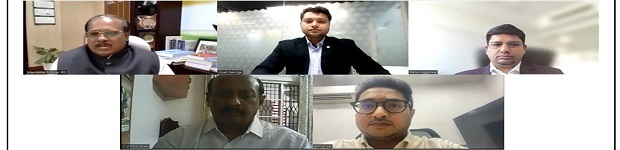
World Trade Center jointly with
FICCI and Export Promotion Council for EOUs & SEZs held an online
session “Overcoming the Challenges of GST e-Invoicing”. BDO India was
the knowledge partner for the event. Mr. Mandalika Srinivas IRS,
Principal Chief Commissioner, GST & Central Excise, Tamil Nadu &
Puducherry was the keynote speaker. Mr. CA. Amrith Lal, Convenor for
Finance & Taxation Panel, FICCI, Tamil Nadu State Council gave the
introductory remarks and Mr. Rahul Aggarwal, Partner & Tax Tech
Lead, Digital Services, BDO India provided the detailed presentation.
In his Keynote Address, Mr. Mandalika
Srinivas IRS spoke about the reduction in threshold for generating
e-invoices to 5 crore annual aggregate turnover. This is applicable for
companies whose annual turnover is 5 crore and above for any FY starting
from 2017-18. Aggregate turnover refers to those with respect of all
taxable supplies plus turnover of exports, exempted supplies, inter
GSTIN transfers under a single PAN. He listed the exempted categories as
– SEZ units, insurance & banking sector, goods transport agencies,
passenger transport services, admission ticket, B2C, exempted supplies
and high CCH. The generation of reference number is required not just
for invoice, but also for debit and credit notes. He opined that the
biggest advantage of this system is a smooth ITC reconciliation,
simultaneous generation of e-way bill, elimination of data errors, and
high reliability. Recipients needs to insist on e-invoices as a normal
invoice generated by an entity which requires to generate an e-invoice
will be considered non valid, including ITC reconciliation. He urged all
to comply with this initiative which will be a win-win for all
stakeholders.
Mr. CA. Amrith Lal remarked that this
action by the Govt has brought about a great degree of standardization
and a lot of MSMEs are now included in the e-invoicing requirement
threshold. He added that penalty is INR 10000 per invoice. He observed
that various companies now require their vendors to fill out a
declaration form where their annual turnover post 2017 -18 is mentioned
and opined that this a good practice to avoid further complications.
Mr. Rahul Aggarwal spoke in detail
about the reduction in the threshold. The Govt of India has listed all
GSTIN for whom e-invoicing is applicable in their GSTN portal. He
mentioned that this is not a GSTIN based requirement, but PAN based. The
system has been implemented in over 70 countries and is predicted to be
the predominant mode of global exchange of commercial documents by
2025. It helps in enhancing fiscal control, cost reduction, boost in
economic savings, pre-population of tax returns, track payments and
control frauds. Asia pacific is expected to experience highest growth in
e-invoicing especially India and China. He listed the various modes of
creating e-invoice such as web, API, SMS, Mobile App, offline tool and
GSP.
Mr. Vivek George, World Trade Center
delivered the welcome address and Mr. C.U. Poovaiah, Regional Director,
EPCES proposed the vote of thanks.